
YLH Trap Field Trial Report
Field Evaluation Report: Apiary Defense & Vespid Trapping Dynamics
Location: Townville, South Carolina
Trial Period: September 8th-27th & 30th- October 7th, 2026
Objective: Evaluate the efficacy, species selectivity, and spatial dynamics of drowning traps vs. dry traps in mitigating predatory pressure on managed honey bee colonies.
Equipment and Bait Configuration
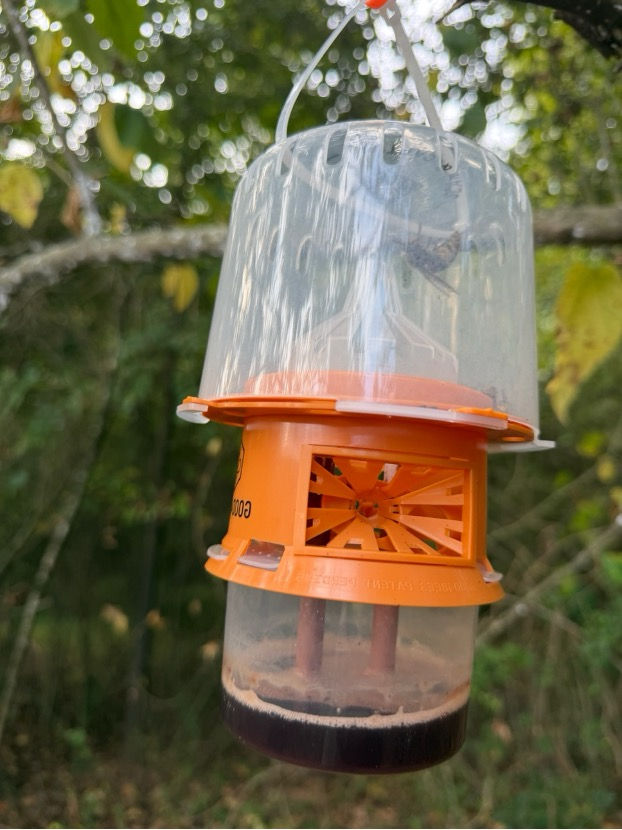
This trial utilized two distinct commercial trap designs to assess catch performance. The first was the Véto-pharma VespaCatch, a commercial drowning trap featuring specialized entrance tunnels designed to capture hornets while utilizing liquid lures. The second was the "GOOD4BEES" Selective Yellow Legged Hornet Trap, a dry-capture trap featuring mechanical exit reducers measuring 5.5mm to 6mm, designed to allow smaller non-target insects to escape while retaining large vespids. For this test both Good4Bees traps were configured to allow larger European hornets entry. Both trap types were deployed at heights ranging from 5-8 feet above ground and baited nearly identically with "Georgia Juice," a fermenting blend of grape juice and brown sugar syrup. 1Cup Dark Brown Sugar, 1Cup Grape Juice, 1Cup Water. The drowning trap bait loads were also given a few drops of Dawn dish soap to facilitate their killing method. The second round of testing in this set was terminated as temperatures began dropping into the 50’s at night and in the face of an extreme weather event, hurricane Isaias.
Individual Trap Placements and Catch Metrics
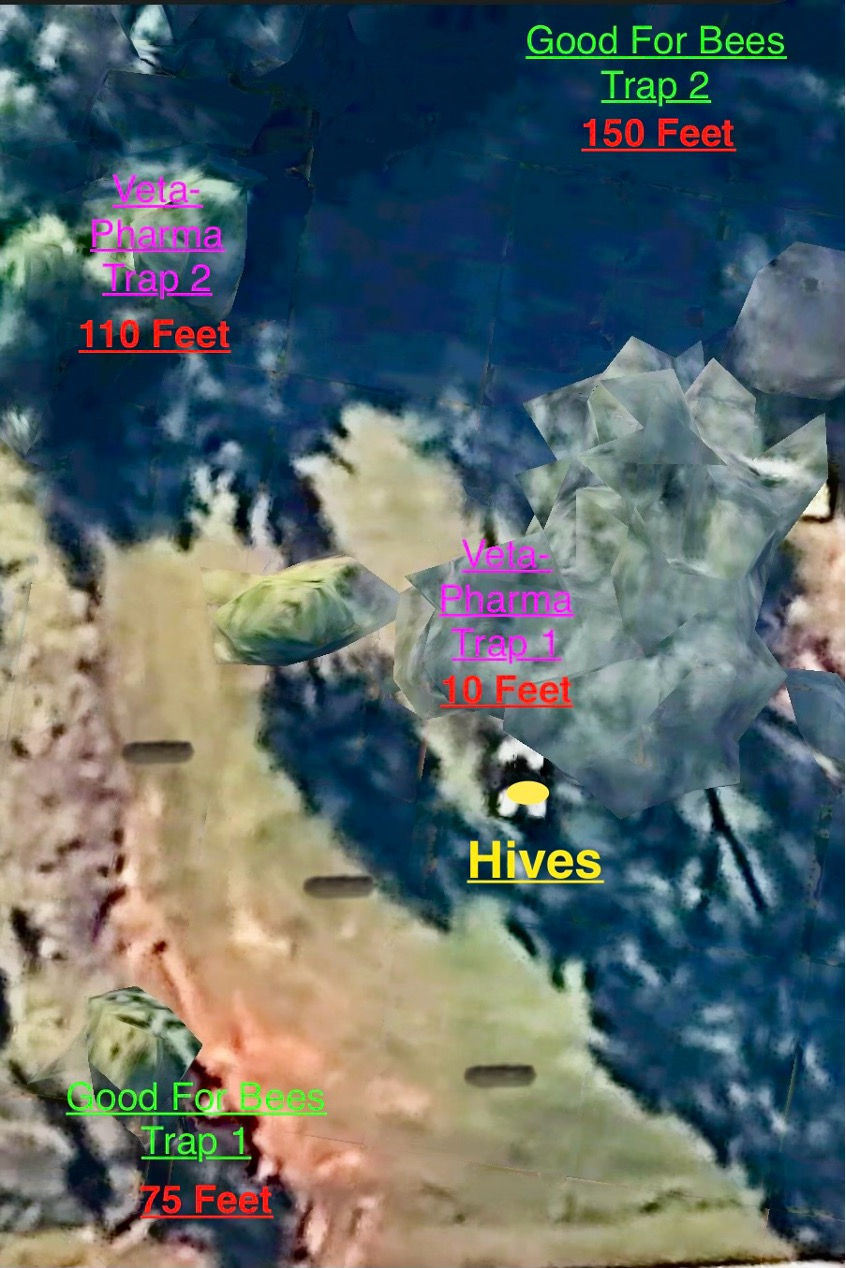
• VespaCatch Drowning Trap (10 feet East of nearest hive): Positioned at an 8-foot height in a shaded location directly within the primary, high-density predation flight path. This configuration yielded the largest overall haul of the trial, catching 25 European Hornets (Vespa crabro) which included one live queen, approximately 185 Southern Yellowjackets (Vespula squamosa), as well as 24+- Nocturnal Moths and a half dozen or so flies of different species. The extreme proximity to the hives completely overrode the shade factor, resulting in a high-volume target and bycatch profile.


Good for Bees Dry Trap 1 (75 feet East of nearest hive): Positioned 5 feet above ground with morning shade and afternoon sun. This unit achieved the largest G4B target catch of the trial, capturing 5 European Hornets and 0 Yellowjackets. This placement represented an optimal selective buffer, intercepting hornets on the wider eastern perimeter without killing bycatch.


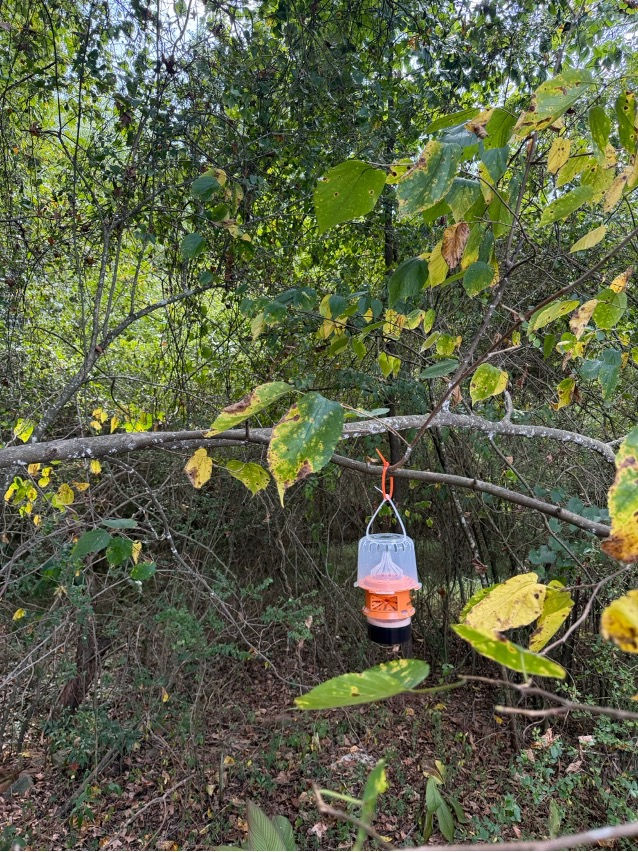
VespaCatch Drowning Trap 2 (110 feet Southeast of nearest hive):Positioned at an 8-foot height inside the tree line with all-day shade. This unit resulted in 100% bycatch, capturing a low volume (20+) of Southern Yellowjackets, a handful of Nocturnal Moths, 2 Grasshoppers, 1 Wasp and 0 European Hornets. Sitting completely outside the hornets' visual and olfactory hive-hunting zone, it functioned strictly as a general woodland fruit-lure.
•


Good for Bees Dry Trap 2 (150 feet South of nearest hive): Positioned at an 8-foot height inside the tree line with all-day shade. This unit resulted in a deep perimeter catchment profile, securing a total count of 4 European Hornetsand 1 large wasp. The slightly lower European Hornet number reflects both the heavy distance drop-off from the apiary and a lack of sunlight to help warm up the bait so that its odor plume was as large as that of G4B Trap 1. Still despite being twice as far from the beehives as GFB Trap 1 and 40’ further away than VespaCatch 2, this trap GFB Trap 2 still managed to draw and exclusively catch vespids.


Key Behavioral and Ecological Conclusions
Spatial Proximity Overrides Trap Design
The trial demonstrated that spatial proximity to the apiary flight path is the primary driver of drowning trap catch volume. Because weak or feeding colonies act as powerful visual and olfactory beacons for hunting vespids, any trap placed within a 10-foot radius will experience exponential catch rates regardless of its mechanical configuration. Beyond a 100-foot threshold, drowning traps cease to provide active apiary defense and instead transition into general woodland monitoring.
Both dry traps with scent diffusers, despite being 7-15 times as far from the beehives as the only productive drowning trap, still managed to attract and catch vespids.
Beginning the morning of September 30th at approximately 7am, after a two-day bait withdrawal period, both GOOD4BEES traps were redeployed after a thorough cleaning using dish soap and water, one at the Veta-Pharma VespaCatch trap 1’s previous 10’ proximity to active hives, and the other placed back at the previously dry trap tested 75’ location. Within the first 10 hour period the newly established 10’ range G4B Trap 1 had attracted and caught 3 European Hornets, as well as drawing Southern Yellow Jackets. Both traps are actively attracting Yellow Jackets while the 75’ range trap has also drawn the attention of an ant colony. The very quick capture of three hornets bolsters the supposition that spatial proximity to active bee hives regardless of trap type, does play a role in catch volume. By the end of the first 48hrs the 10’ G4B Trap 1 caught 3 European Hornets and 1 Bald Faced hornet. While it continued to draw Yellowjackets and eventually ants, it did not catch any more large vespids once 4 corpses were inside the catch chamber. The 75’ range G4B Trap 2 failed to catch any large vespids at all until after there was a rainy day. It caught one within 24 hours and then two more within 72hrs post rain. This suggests that not just the trap is marked by alarm pheromones warning other large vespids off, the vented capture chamber seems to allow for those emitted scents to drift and designate the area as dangerous. The 75’ trap despite its distance from the hives, is the only trap catching that had not yet reached the 4 vespid corpse threshold, it had however added one very large moth to its catch chamber. It either managed to escape by the time the trap was taken down or was dismantled and consumed by the trapped hornets and foraging ants.
The Drowning Trap Scent Mask vs. Dry Necrophobic Stalling
A critical operational divergence was identified between the two trap mechanisms. Dry traps (G4B) hit a "peak corpse density" wall. When vespids die a dry, stressful death inside the chamber, they release oleic and linoleic acids—universal insect "death scents"—alongside active alarm pheromones. Because these airborne chemicals vent freely through the dry exits, they eventually override the sweet bait smell, flagging the trap as a danger zone and warning later predators away. 4-5 corpses in the dry capture chamber seemed to be enough even with full bait cups feeding the diffuser reeds.
Conversely, drowning traps (VespaCatch) maintained a continuous catch capability. The liquid bait encapsulated the dead insects, chemically masking the warning scents. Over time, the decaying organic matter broke down alongside the fermenting sugars, actually increasing the trap’s long-term attractiveness rather than repelling new pests by adding protien.
During the second round of testing the G4B traps the peak corpse density theory was supported by the evidence. 4 large vespid captures despite being within 10’ feet of the active beehives completely eliminated any further catch, while the 75’ range trap continued to attract and capture European Hornets. Clearly in the case of European Hornets and tentatively Bald-Faced hornets, Necrophobic stalling is a factor with using dry traps. Yellow Legged Hornets, like their smaller Yellow Jacket cousins may not care at all. Their actual behavior will need to be observed regarding this issue but it is likely that it will fall in line with what has already been observed with other large sized vespids.
Exposure to Sunlight
Solar heat accelerates the vaporization of the juice lure in the (G4B) bait basin, this expands the trap's olfactory radius but causes the bait to disappear at a significantly increased rate. The exposed trap needed to have its bait refreshed at a greater than 2-1 frequency than the tree line trap, and both did need their basins refilled repeatedly.
Neither of the drowning traps needed their bait pools refreshed over the duration of the test.
During the second round of G4B trap testing enough leaves had dropped around the 10’ location that both traps were similarly as exposed to the elements necessitating a 48-72hr bait refill interval.
Complete Primary Pollinator Safety
Across all test locations and trap configurations, zero Honey bees or Bumble bees—were caught. The fermenting organic compounds of the "Georgia Juice" effectively repelled honey bees, while the physical barriers and escape vents of the GOOD4BEES traps successfully eliminated any bycatch, excluding one very large wasp and one very large moth.
Final Thoughts
The dry scent diffuser traps used in this test were able to draw and catch vespids from much further away than the drowning traps and resulted in negligible bycatch. The drowning traps completely depend on proximity to active bee hives and result in bycatch that is hundreds of times higher than the targeted pest catch and the total bycatch that resulted from the dry traps. The yellowjacket majority bycatch are not primary “beneficial pollinators” but they do have a place ecologically as predators, secondary pollinators and as a protein source in their own right for other wildlife. As the newest threats (Yellow Legged Hornets) to our local honey bee population expands into our nation as a whole, limited solely by geographic and environmental conditions, drowning traps offer an easier management schedule in that they do not have peak corpse density issues and do not need to be rebaited frequently. That is attractive. The ecologic down side is obvious however, especially over the long term.
Depending on the behavior of the Yellow Legged Hornet the GOOD4BEESdry trapping system will function very well as a monitor for presence with the traps tuned down in size with the included adapter to exclude European Hornets. Should Yellow Legged Hornets disregard alarm pheromones and death scents these traps could also function as a direct defense when placed in close proximity of active hives within an apiary. The serious downside when being deployed nationally, or on a state wide level, or within an apiary, is trap exposure to the elements making a frequent rebaiting schedule a must where drowning traps can go for much longer intervals.
Neither trap system is perfect. For active apiary defense, a hybrid that combines the benefits of a drowning traps much lower bait maintenance requirement combined with the bycatch escape ports incorporated into the dry traps design, should cut down on the extreme overkill of other native insects. In the US the European hornet is just as undesirable a predator in our apiaries as the Yellow Legged Hornet, even if they do not appear to be as voracious when it comes to attacking our bees, so tuning traps that are set to actively defend against vespids to exclude Europeans is not necessary.
If Europe has anything to teach us about Yellow Legged Hornets it is that they are here to stay, mitigation is the only viable path forward, and that manual single nest location/eradication is extremely expensive. The practice will quickly run out of funding and exhaust any political backing for additional funds when it becomes plain that the task will be never ending.
At this point, the logical place to disburse research funding to combat this new pest, is directly into research that targets Yellow Legged Hornet biology in an effort to find a unique method of action targeting this individual species vs other native vespids.
Kelly Davis
Certified Beekeeper
ACBA/SCBA Member
Notes:
*This was the second year of testing for the Véta-Pharma drowning trap system, its full “as intended” deployment however is unlikely to ever happen here in the US due to insurmountable EPA regulatory hurdles regarding the proprietary bait chemical paired with the trap by the manufacturer. The results of the previous year’s test were a direct mirror image of this one with the addition of finding an inebriated Green Anole lizard swimming in the Georgia Juice and feasting on insect corpses. The anole was released without harm, albeit somewhat purple from the grape juice.
**24hrs before the 10’ range G4B trap was set to be taken down before the hurricane arrived, the catch chamber was emptied, without washing and left in place. The residual bait in the basin continued to draw yellow jackets. One large European hornet did alight on the trap but seemed more intent on eating small flies that were also attracted by the bait. It did actually poke its head into the trap entrance but immediately backed out and spent the remainder of the waning daylight period hunting flies. The next morning the trap remained empty. It was subsequently taken down the trial concluded.
*** As of this post, YLH has been confirmed in Anderson County.


Comments